March 19, 2013

Lenin’s statue overshadows royal visit in Assen

Filed under: History by Orangemaster @ 12:45 pm

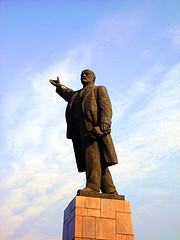
A 10-metre-high statue of ‘our friend’ Lenin has been adorning downtown Assen since last November, as promotion for the exhibition The Soviet Myth currently featured at the Drents Museum.

Now that the future king Willem-Alexander will be visiting Assen in late May, the statue is in the way, as it blocks a big part of downtown used for big events like the famous TT motor race. And let’s face it, Lenin has surely killed the buzz of many a party in the past so he can surely make himself scarce again for some royals. (Someone please notice all the historical references crammed into that one sentence).

A huge statue that apparently weighs 17,000 kilos has not only become a royal eyesore, but its placement has been controversial from day one. Responsible for the death of hundreds of thousands of people if not more, a ‘Stalin light’ if you will, having a statue of Lenin around is seen by many as just plain gross, although I do get the fascination factor. I wonder if any Dutch museum would do the same if Stalin or even Hitler were featured.

(Link: www.parool.nl, Photo of Lenin in Ukraine by covilha, some rights reserved)

Tags: , , , ,

March 18, 2013

Film ad for Dutch wave pool (1953)

Filed under: History by Branko Collin @ 10:20 am

This video from 1953 shows an advertisement for an outdoors salt water wave pool called Bad Boekelo.

The film is called Zee op de Heide, ‘Sea on the moor’, which is ironic because Boekelo near Enschede is about as far away to the east of the North Sea as possible in the Netherlands. The video describes the wave pool from about 2 minutes in: “An ingenious construction with two mechanically moving doors creates a real surf.” The hotel was built to give the business people dealing with the nearby salt industry a place to stay, and filling the pool with the salt from nearby salterns must have been a nice gimmick.

The hotel still exists, but the wave pool (which was built around 1934) has been turned into a pond. The name of the salt company, then called Koninklijke Nederlandse Zoutindustrie, still survives in the KZ of Akzo Nobel.

Note that completely by accident this has become the third posting in a row where I describe the demise of a notable pool or resort in the Netherlands.

(Video: Youtube / Historisch Centrum Overijssel. Image: still from the video.)

Tags: , , , , ,

March 17, 2013

Photos of an abandoned public pool in Rotterdam by Frank Hanswijk

Filed under: Architecture,Photography by Branko Collin @ 8:52 pm

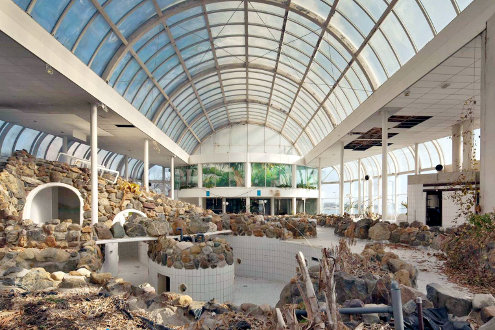
Public swimming pool Tropicana was built in 1988 on the Maasboulevard in the heart of Rotterdam and closed its doors again in 2010.

The Vers Beton blog asked photographer Frank Hanswijk to go and take a peek, which he did. He created a short photo report in which he documents the rapid deterioration of an abandoned public pool. In as short a time as three years the water has receded and most of the plants have died, and in their stead rust and dirt are conquering every inch.

In the 1980s tropical themed public pools became popular in the Netherlands—at least in my recollection. These pools focussed less on lap swimming and more on other types of recreation. They were typically equipped with water slides, whirl pools, wave pools and so on, and were nicknamed subtropische zwemparadijzen.

(Link: Trendbeheer, Photo: Frank Hanswijk)

Tags: , , , , ,

Kurhaus and pier in Scheveningen in decline

Filed under: Architecture,History by Branko Collin @ 12:42 am

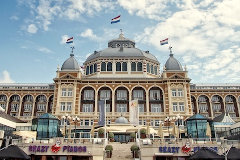
The Kurhaus Hotel in Scheveningen near The Hague is bankrupt, Omroep West writes.

The hotel is owned by seven anonymous private investors who bought it in 2004 for 46 million euro and is run by the German Steigenberger Hotel Group. At the time the purchase was supervised by Willem Endstra, who was accused of being banker to the underworld and who was murdered shortly after. Steigenberger has denied that there are financial problems and has declared that business will go on as usual, according to Misset Horeca.

Meanwhile the nearby pleasure pier, another icon of seaside resort Scheveningen, is also heading towards bankruptcy. The curator has decided to put the pier up for auction. It is currently owned by known tax evaders Van der Valk Hotels who bought it for 1 euro in 1991 of insurer Nationale Nederlanden who wanted to get rid of it because of the high maintenance costs, NRC writes.

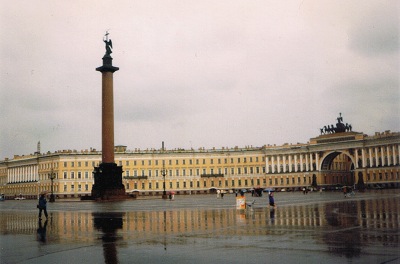
The origin of Scheveningen is hidden in the mists of time, but towns with names ending in -inge originate from the 10th and 11th century according to Wikipedia. As the nearby The Hague turned from the hunting lodge of the counts of Holland to the seat of the government of the Republic of the Seven United Netherlands, the fishing community of Scheveningen grew. In 1665 the two towns were connected by a paved road and from 1800 onwards Scheveningen developed into a seaside resort with hotels and villas being built to the northeast of the harbour.

In 1884 the Kurhaus was built, a hotel which doubled as a spa. The Kurhaus was connected to the pier via a bridge. (In World War II the original pier burned down—a new pier was built a bit further up North in 1959.)

According to history blog Geschiedenismeisjes, Kurhaus was still an icon of tremendous luxury at the start of the 20th century. During World War I, in which the Netherlands managed to stay neutral, the hotel was the location of a culture clash between new and old money. A group of people who had gotten rich during the war, the so-called ‘oorlogswinstmakers’ (war profiteers) flaunted their wealth in Scheveningen. And in 1919 a labour law was passed that made leisure time for workers obligatory—the hours that a person should work per day were limited to 8 and the Sunday would be a day off. This brought spending time at the beach suddenly within the reach of the working classes.

(Photo by MichielJelijs, some rights reserved)

Tags: , , , , , , , , , ,

March 15, 2013

Sexual violence at school is part of student life

Filed under: General by Orangemaster @ 11:27 am

Four out of five teachers at schools witnessed sexual violence in 2012, which according to researchers, is not translating into preventive measures, so students have no idea what is OK and what is not. Some 12% of students have been a victim of sexual violence, which includes unwanted gestures or comments (harassment), being touched, groped, assaulted and raped. If I were a bad student, my boundaries would be what I can get away with without being caught. How can schools make a big deal out of teaching children about sexuality and even homosexuality, but not deal with preventing sexual violence? Or we’ve missed something.

Sexuality research institute Rutgers WPF has said that all secondary schools should draw up rules to make it clear that some forms of sexual behaviour are unacceptable. I am surprised this doesn’t already exist, and if it does, it should make the papers as well.

Forcibly putting one’s tongue into someone else’s mouth is now no longer be classified as rape, according to Dutch courts this week. Imagine, French kissing (in Dutch, ‘tongzoenen’, or ‘tongue kissing’) was considered rape, but all of the above is still taking place in school.

I remember a boy who was taller and more developed than the rest of us in my first year of secondary school had poked me very hard in the ‘breast’. I was wearing overalls and he basically pushed really hard on the button part several times. I waited until he walked off and kicked him in the balls from behind, forcing him to the ground. I was dead scared he would beat me up, but because his friends saw it, I was OK. Not defending myself would have made it worse, à  la Freaks and Geeks.

(Links: Dutch News, www.nrc.nl)

Tags: , , , ,

March 14, 2013

24oranges celebrates Russia -The Netherlands 2013

Filed under: History by Orangemaster @ 12:42 pm

In addition to a year chocked full of serious cultural activities that feature the Russian-Dutch connection, 24oranges proudly presents some articles you might have missed that have a bit of the Russian soul in them as well:

1. ’50 years of human space flight’ out now

Dutch-Canadian writer Steve Korver has this obssession with Russian cosmonaut Yuri Gargarin that will suck you in as well.

2. Russian goes free thanks to Google translation error

It reads like a bad Russian joke and it reminds us all that a real translator beats a human being any day of the week.

3. Dutch Eurovision entry: cultural suicide

Dutch Eurovision’s entry in 2010 was a flop from the get-go and mentioned Leningrad, which was the name of the Russian city of Saint-Petersburg between 1924 and 1991.

4. Hiddink not happy with vodka named after him

We have lots of vodka-related stories, but this one was a good one. Hiddink’s spokesperson said that he never wanted to be associated with tobacco, alcohol or sex, so I guess that means vodka as well.

5. Maybe the Dutch king should have a beard

Once you get past the actual story, there’s a nice educational bit about Peter The Great taxing men with beards and his historical role in changing the Russian alphabet.

Tags: , , , , , ,

March 13, 2013

The perfume that had everything

Filed under: Art by Branko Collin @ 8:17 pm

Amsterdam-based artists Lernert & Sander write:
Everything is a perfume by Lernert & Sander consisting of all fragrances launched in 2012. Over the last year Lernert & Sander collected almost 1400 samples of newly launched fragrances. By mixing the content of all of these bottles, they created 1.5 litre of Everything. This unique perfume comes in a specially designed and hand blown bottle, an enlargement of a classic sample bottle.

The result? Eric Wilson of the New York Times wrote:

It smelled, at first whiff, of strawberries mixed with salt, along with hints of baseball mitt and hair spray. And tuberose, yes. And licorice and fresh paint. And musk and rotten peaches and honeysuckle and basil and soap.

It was awful.

Apparently a bottle of 1400 free samplers goes for 30,000 euro these days.

The Huffington Post quotes the artists themselves:

“When Lernert tried it on in our studio yesterday and took the tram, the unbelievably handsome man that came to sit next to him instantly got up and found another seat after smelling Everything,” said Lernert and Sander via email. “But, hey, Everything is not for everyone.”

(Video: Vimeo / Lernert & Sander. Photo: video still)

Tags: , , , ,

March 11, 2013

Dutch youths take extra driving lessons to lower insurance

Filed under: Automobiles by Branko Collin @ 10:19 am

Young men from the countryside are the worst drivers, according to Spitsnieuws.
This is why they have been taking supplementary driving lessons in droves, according to the online paper. Last year 12,000 Dutch youths participated in a program called ‘Trials’ in which they were taught how to perform emergency stops, how to control a skid and how to drive trucks. This is up from 10,000 in 2011. The program is run by several insurers who give successful participants a no claim discount.

Participation in the one-day programme costs 60 euro and is open for 18-28 year-olds from the provinces of Groningen, Friesland, Drenthe, Overijssel, Zeeland and Flevoland.

The Verbond van Verzekeraars (Association of Insurers) claims that the number of accidents with damage was 25% lower for participants than it was for people who did not participate.

Some figures:

  • At age 18 one can get a drivers license in the Netherlands.
  • 510,000 Dutch people of age 27 or under drive a car.
  • The risk for people aged 18-24 to be in a car accident is 4 times that of people aged 30-59.
  • People under the age of 27 are involved in 76,000 car accidents each year.

(Note that those numbers do not neatly fit together. The number of 31,000 accidents where at least one party was not insured for liability might not have involved a single youth and the lack of insurance might not have been on the side of the guilty party. This story was basically copy written by an insurance company for the main stream media, so take these things with healthy doses of salt.)

Tags: , , ,

March 10, 2013

Table with rubber legs by Wout Wessemius

Filed under: Design by Branko Collin @ 12:27 pm

Wout Wessemius likes to use rubber in structures. His website showcases tables, chairs, sofas and even a log cabin made of rubber, or least covered with the stuff.

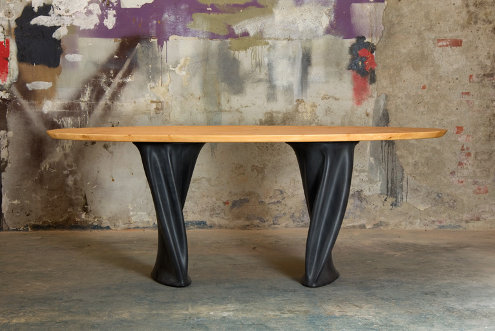
This table, called the Chapli, has two twisted rubber legs with a frame of steel and a wooden top. It is also available as a smaller model with a round top and one leg. Pricing seems to be unavailable, dimensions can be altered on demand.

According to House of Design, Wessemius sources a lot of his materials at the junk yard.

(Link: Trendhunter. Photo: Wout Wessemius)

Tags: , ,

March 9, 2013

Lack of women in top management roles in the Netherlands

Filed under: Weird by Branko Collin @ 2:55 pm

In the Netherlands 11% of all senior management positions are occupied by women.

Trouw likens the Netherlands to an emirate when it comes to the number of women in top management positions. (I believe they intend that to be an insult, which would be interesting in itself.) For comparison, the United Arab Emirates also sits at 11%. Since this year corporations and government agencies in the UAE are required to have women on their boards.

Of the developed countries (for want of a better word) only Japan fares worse. It has 7% women in management roles. The most emancipated country in the world is China with 51% of all big bosses being women. In fact the top ten of countries has seven nations in it that either are or used to be communist. (The word ‘socialist’ and ‘communist’ are oddly lacking from the Grant Thornton report (PDF) that Trouw bases its article on.)

Dutch women do not seem to be very interested in having careers, although they do like having the opportunity of having careers. In 2010 the United Nations voted the Netherlands the most gender equal country in the world.

(Illustration: public domain version of the symbol of feminism, via Wikimedia Commons)

Tags: , , , , , , ,